
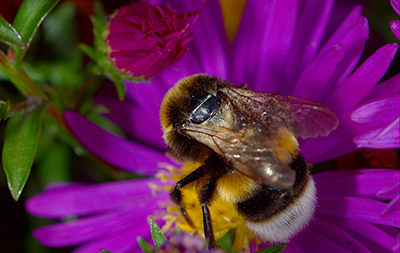
 Bumblebees are important pollinators and one common UK species (Bombus terrestris) can even be purchased for greenhouse pollination.
But bumblebees are declining in numbers and we don’t really know why. An obvious possible reason is the decline in the extent and quantity of wild flowers that provide food for the bees. Maybe insecticides, too, have played a role.
The best estimate we have is that bumblebee numbers have declined by 50% in the last 30 years and one species has probably died out.
There are three things that bumblebees need:
1: Somewhere to go overwinter
For the winter, the queen needs a place to hibernate.
She will usually choose a place that is out of the sun – perhaps under a tree root or a cavity in a wall. Why do you think she chooses a place out of the sunlight?
2: Something to eat
In early Spring, when the queen emerges from hibernation, she first searches for food, to replenish her spent stores of body fat.
You can help by ensuring that you have a succession of flowers that will span the season.
Make sure that you include spring flowering plants as well as the showy summer ones. The bumblebees need a continuous supply of nectar and pollen.
You don’t need a garden to encourage bumblebees. A window box planted with suitable flowers will attract them. The cheapest way to plant a window box is to buy a pack of mixed seed from one of the big seed suppliers. They may have a selection just for bees or it may be called wildlife or wild flower mixture.
You could pop some violas and spring flowering bulbs in your window box in Autumn so that you have a fine show of spring flowers that provide colour, and also for the queen bumblebees, an essential source of nectar and pollen.
3: Somewhere to nest
The queen bumblebee will also be searching for a place to nest. You can provide a suitable, secure place.
Nesting sites for bumblebees – the DIY solution
Bumblebees find nest sites that are warm, dry and dark. Often they choose burrows made by small rodents, but different species have different preferences and only recently has a full-scale survey of nesting sites been carried out in the UK, by the Rothamsted Research labs . Although these results haven't yet been published, quite a bit of experience has been built up in providing artificial nests and we give you three suggestions here.
For the solitary mason bee
You need hollow bamboo or buddleia stems, all cut to the same length, and an old tin (a coffee tin would be perfect). The hollow stems are pushed into clay in the base of the tin; the tin is then suspended from a tree or post with the stems horizontal, pointing towards the sun and angled so that they don’t fill with water. There's also this blog guide on how to build a mason bee house in 5 minutes.
For bumblebees that nest at ground level
Acquire an old teapot, place a small amount of cotton wool or waste inside and bury it with just the spout exposed. Choose a place where the ground will catch the sun but not get baked, where nobody will trip over the spout and where the teapot will not fill with water.
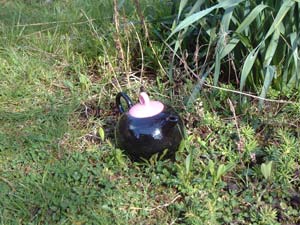
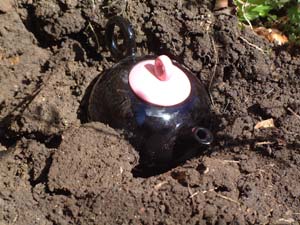
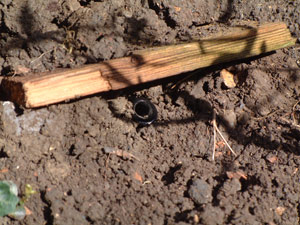
Fancy making your own?
Download our beebox blueprints [pdf document] and follow these instructions, to build a palatial residence! Place it up to a foot above the ground where it will be safe from flooding. You may have to wait for more than one season for it to be occupied, so if you have the space, make two or three.
Use scrap wood if possible. Once your nest has been occupied for a season it is safest to dispose of it as it is difficult to sterilise wood. Use a length of plastic pipe to provide an entrance hole that simulates a natural burrow. The inside should be a dark colour as natural burrows would not be reflective. The lid should overlap the box on all sides and could be covered with roofing felt.
Place the box 10 to 20 centimetres above ground level, standing on a couple of bricks to prevent the base getting too damp and to avoid the risk of flooding.
More about bumblebees
Where they nest:
Bumblebees nests (Bumblebee Conservation Trust)
Identifying bumblebees:
Quick quide to six species from the Natural History Museum
Top tips for bee ID from the Bumbleebee Conservation Trust
General information:
The latest bee news from The Guardian
Rate and Review
Rate this article
Review this article
Log into OpenLearn to leave reviews and join in the conversation.
Article reviews